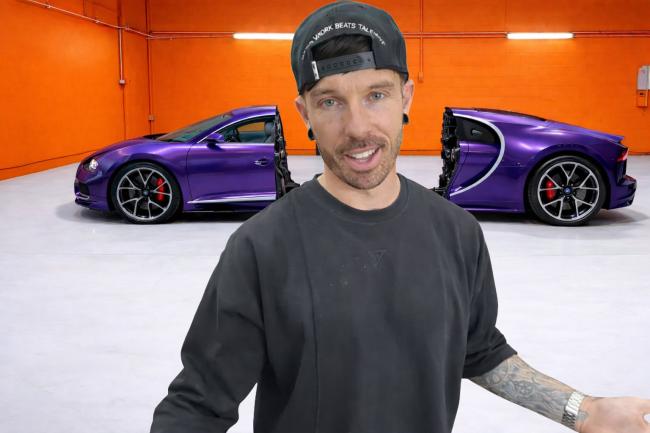

When Bugatti Said “Impossible”, Mat Armstrong Turned It Into a YouTube Series

When Experts Say “Don’t Try”, Creators Hit Record

Most hypercars that suffer major crashes disappear from public view.

They are quietly repaired by specialist technicians or written off entirely. Few people outside the manufacturer ever see what happens next.

When a crashed Bugatti Chiron Pur Sport appeared at a salvage auction, the expected outcome was the same.

Instead, the owner asked YouTuber Mat Armstrong to attempt the rebuild on camera.

When Bugatti raised concerns about repairing such a complex hypercar outside its official network, the project became something much bigger than a car repair.

It became a story about curiosity, engineering, and what happens when a creator decides to try something the experts say should not be attempted.

Mat Armstrong separating the chassis of a Bugatti Chiron Pur Sport during the rebuild
Danielle

Heading
The Bugatti Rebuild That Wasn’t Supposed to Happen

Body

Regular viewers of Mat Armstrong’s channel know how most rebuilds begin.
A damaged car arrives at the workshop, everyone gathers around it, and the first episode usually starts with the same question: how bad is it really?

Panels come off, parts are labelled, and with every step the real story slowly reveals itself.

The Bugatti rebuild started differently.

Armstrong’s enthusiasm for the brand is well known among viewers. He even has a Bugatti logo tattooed on his leg, something that makes the rebuild feel slightly more personal than most projects.

Instead of waiting for the car to arrive in the UK workshop, Armstrong flew to Miami to see the wreck for himself.

Seeing the car in person was a very different experience from watching a salvage listing online.
Panels were misaligned, suspension components had shifted, and it was immediately clear that this was far from a simple repair.

Even for someone used to rebuilding performance cars, the scale of the damage raised an obvious question.

Could this actually be put back together?

A car like this is not a normal vehicle. The Chiron Pur Sport is a limited-production hypercar with an 8-litre quad-turbo W16 engine producing around 1,500 horsepower and a carbon-fibre monocoque chassis. Repairing one normally means returning the car to Bugatti’s official repair system. Instead, something unusual happened.

The owner repurchased the damaged car from a salvage auction and asked UK YouTuber Mat Armstrong to attempt the rebuild publicly on his channel. 

Armstrong’s videos typically show damaged performance cars being dismantled, repaired, and returned to the road. He openly explains that he is not formally trained and learns many techniques during the rebuild process itself. Applying that approach to a multi-million dollar Bugatti immediately made the project interesting. Not just because of the car, but because of the question behind it.

Could a YouTube mechanic rebuild something that normally only specialists touch?

Heading
Why This Became Perfect YouTube Content

Bullets Multi

Many YouTube videos struggle because they lack a clear narrative.

The Bugatti rebuild had one from the start.

From the very first episode, viewers could sense this rebuild would be different.

Instead of a quick teardown revealing a clear repair plan, every step seemed to uncover another unknown.

The series includes all the ingredients that make long-form creator content work well:

  • A clear goal
    Rebuild one of the most complex hypercars ever produced.

  • High stakes
    The car is worth millions and contains extremely specialised engineering.

  • Uncertainty
    No one knows the full extent of the crash damage at the start of the series.

  • Visible progress
    Each video reveals new discoveries and moves the project forward.

When these elements are present, a project naturally becomes episodic. Viewers return to see the next step because the outcome is still unknown.

Heading
The Moment the Challenge Became a Story

Body

The project gained even more attention when Bugatti leadership publicly raised concerns about the rebuild.

Certain structural procedures on the Chiron, particularly separating parts of the chassis and drivetrain assembly, are normally performed only by specially trained technicians. 

Bugatti’s position was framed around safety and liability. The company emphasised that rebuilding such a complex hypercar outside its authorised repair process may introduce serious risks. 

With Bugatti unwilling to supply replacement components for the rebuild, Armstrong and his father were forced to find creative solutions.

In several cases, they fabricated or adapted parts themselves, including damaged hoses that would normally be replaced through the official repair network.

From a creator perspective, this moment changed the narrative.

The rebuild was no longer just a repair project.

It became a challenge. 

At that point, the rebuild stopped being just another project on Armstrong’s channel.

It had become something larger. A YouTuber attempting work that even Bugatti suggested should only happen inside its own repair system.

Armstrong framed the goal in simple terms. If only a very small number of places in the world can perform this work, could a normal workshop do it too?

That question turned the rebuild into a story viewers wanted to follow.

Heading
The “Impossible” Job

Body

The rebuild reached its most dramatic moment when the team prepared to separate the chassis.

For viewers, this was the step that would reveal whether the project had a real future. If the crash had distorted the structure, the process could expose far worse damage hidden inside the car.

Slowly, the sections began to move apart.

This process is critical because crash forces can push the engine and transmission out of alignment or damage structural mounts hidden inside the vehicle. Using a standard workshop lift and improvised support equipment, Armstrong and his team separated key vehicle sections to expose more serious damage in the drivetrain area. 

The moment became a milestone in the story. Viewers could see that the project was moving from speculation into real engineering work.

Even people who doubted the rebuild were now watching to see what would happen next, and in the next installment the moment came to bring the car back together.

Using a simple refuse dolly and careful alignment, Armstrong and his team managed to reconnect the two halves of the Bugatti using the fourteen structural bolts that hold the chassis together.

It was the exact step Bugatti had suggested could not realistically be performed outside its specialised repair facilities.

Heading
Even the Critics Helped the Series Grow

Body

One of the most interesting aspects of the Bugatti rebuild is the amount of discussion it created online.

By now, Armstrong’s audience knows the rhythm of the channel. As Sunday evening approaches, social media begins filling with the same question: Is the video dropping at six?

When the episode finally appears, viewers gather in the comments to debate the next stage of the rebuild. Some are convinced the project will succeed. Others are certain the damage will prove too much.

Some viewers see the project as an impressive demonstration of curiosity and persistence. Others believe that vehicles of this complexity should only be repaired within the manufacturer’s official system.

From a YouTube perspective, both reactions are valuable. Debate creates conversation, and conversation increases visibility.

Videos that spark discussion often produce:

  • large comment sections

  • response videos

  • forum threads

  • social media debate

Not every successful YouTube video needs universal agreement. Sometimes the most engaging projects are the ones that raise interesting questions and invite viewers to form their own opinions.

Heading
Turning a Complex Rebuild Into a Watchable Series

Body

Repairing a hypercar involves thousands of components and technical processes. Without structure, that kind of project could easily become confusing content.

Like many of Armstrong’s projects, the rebuild rarely feels like a solo effort. Friends appear to help with difficult tasks, ideas are debated around the car, and one familiar figure is never far away. Armstrong’s father has become a favourite among viewers. While he often provides the humour in the workshop, he is also an experienced mechanic whose advice frequently shapes the next step in the rebuild.

The Bugatti rebuild also brought in specialists from Armstrong’s wider circle. One key moment came when his friend Bob from the machine shop, an engineer and welder, helped repair the damaged engine mount.

The mount is a critical structural component, and the repair not only solved the problem but arguably made the part stronger than before.

In one particularly creative moment, Armstrong even extracted torque specifications by carefully watching Bugatti factory videos where brief glimpses of the settings appeared on-screen.

What Armstrong does well is break the rebuild into clear stages.

Each video asks a specific question:

What damage is hidden inside the car?
Can the drivetrain be removed?
Which parts can be repaired or replaced?
What will it take to get the engine running again?

This approach turns mechanical work into storytelling.

Creators who structure their videos around clear questions help viewers stay engaged even during complex projects.

Many creators now plan these types of series in advance. Tools such as TubeSpanner help break large ideas into individual videos, titles, and scripts so the story unfolds clearly for the audience.

Tip

Image
Tip

Title
You Don’t Need a Bugatti

Body

The real lesson from this series is not about hypercars.

It is about recognising projects that contain natural storytelling elements.

Look for ideas that include:

  • a challenging goal

  • real uncertainty

  • visible progress

  • a reason for viewers to return

These ingredients turn ordinary projects into series people want to follow.

Heading
Why the Bugatti Chiron Is So Difficult to Repair

Body

Part of what makes this rebuild so fascinating is the complexity of the car itself.

The Bugatti Chiron Pur Sport is not just another performance vehicle. It is built around a carbon fibre monocoque chassis and powered by an 8-litre quad-turbocharged W16 engine producing around 1,500 horsepower. 

Vehicles at this level are engineered as tightly integrated systems. The drivetrain, cooling systems, suspension geometry, and electronics are all designed to work together under extreme loads.

That means crash damage can affect far more than body panels.

Structural components, drivetrain mounts, and cooling systems may all need inspection. Some of these areas are normally accessed through specialised procedures that are carried out only by technicians trained on the vehicle platform. 

This is one reason Bugatti raised concerns about rebuilding the car outside its authorised repair network. Hypercars like the Chiron are designed to operate at speeds and performance levels where structural integrity and system calibration are critical. 

For viewers, however, that complexity is exactly what makes the rebuild series so compelling.

Every time the car is dismantled further, the audience gets to see how one of the world’s most advanced road cars is actually built.

During the teardown, Armstrong also discovered something viewers found surprising.

Some components inside the Bugatti share design similarities and even parts used in Volkswagen vehicles, a reminder that even ultra-exclusive hypercars sometimes draw from wider engineering ecosystems.

Heading
The Bugatti Rebuild Timeline So Far

Bullets Multi

1. The Crash
The story begins with a serious crash involving a Bugatti Chiron Pur Sport, a limited production hypercar built with a carbon fibre monocoque and a highly specialised drivetrain. The owner received an insurance payout after the accident but later bought the damaged vehicle back through a salvage auction. 

2. A Different Repair Plan
Instead of sending the car back to Bugatti’s official repair facilities, the owner partnered with YouTuber Mat Armstrong to attempt the rebuild publicly on his channel. This immediately made the project unusual because hypercars are rarely repaired in full view of the internet. 

3. The Industry Pushback
Bugatti leadership publicly warned that some of the procedures required to repair the vehicle are normally carried out only by a very small number of specially trained technicians. The company framed its concerns around safety and the risks of repairing such a complex vehicle outside the authorised repair network. 

4. The “Impossible” Challenge
Rather than abandoning the rebuild, Armstrong turned the moment into a challenge. If certain structural procedures were considered extremely rare, the goal became to prove whether they could still be performed in a well-equipped workshop.

5. The Chassis Separation Milestone
One of the most dramatic moments in the series came when Armstrong and his team separated major sections of the car to inspect the drivetrain and internal damage. The operation revealed deeper structural issues but also demonstrated that significant progress was possible outside the official repair system. 

6. After reassembly, the moment everyone had been waiting for arrived.
The engine started on the first attempt, and the car successfully engaged gear, proving that the rebuild had progressed far beyond what many viewers initially believed possible.

7. The Story Continues
The rebuild is still unfolding. Each new episode reveals additional discoveries, parts sourcing challenges, and technical hurdles. For viewers, that uncertainty is part of the appeal. The outcome is still being written.

With the mechanical work largely complete, the final stage of the story now appears to be bodywork and finishing touches before the car can drive again.

Heading
What Creators Can Learn From the Bugatti Rebuild

Body

The Bugatti rebuild is still unfolding, and no one knows exactly how the story will end.

But in many ways, the most interesting part has already happened.

A creator looked at a project most people would never attempt, turned on a camera, and invited millions of viewers to watch the process unfold.

Ambitious ideas attract attention. Projects that seem difficult or unusual naturally generate curiosity. Transparency builds trust. Showing the process, including mistakes and unexpected discoveries, helps viewers feel part of the journey. Discussion drives visibility. Even viewers who disagree with a creator’s approach often contribute to the conversation around the content.

For creators building their own channels, the challenge is not finding a Bugatti to rebuild. It is finding projects that combine curiosity, challenge, and progress in a way that viewers want to follow.

Planning tools like TubeSpanner can help creators organise those ideas into structured video concepts and scripts, making it easier to turn an interesting project into a consistent YouTube series.

Title
Turn Big Ideas Into Structured YouTube Videos
Body

Great YouTube series rarely happen by accident.

They start with an idea, then grow into a sequence of videos that viewers can follow.

TubeSpanner helps creators transform rough ideas into structured video plans with titles, scripts, and production guidance.

If you are thinking about starting a channel or planning a project series of your own, explore how TubeSpanner can help organise your ideas and turn them into videos.